A hobby blog to get tips, ideas, reviews, resources, interests, leisure, pastimes, recreation, entertainment and travel.

Search This Blog

Follow Me on Pinterest
Showing posts with label knives. Show all posts

Sunday, February 5, 2012

Type and uses of knives

Knives are one of the most ancient tools prepared by humans. A knife is basically a sharp edged tool, which is used to cut different objects. It usually comprises of a blade, which is attached to a handle. The knife is man's oldest tool. Tools that were the very instruments early man (hunter/gatherer) used to keep himself fed. The knives at that time were truly "hand made". Early man fashioned his knife out of thin pieces of stone. 

The first knifes used in the Stone Age were made of either flint orflint or rock, their edge was chipped or ground, and they sometimes, but not all the time, had a handle. With later advances in smelting and metallurgy, blades were able to be made of bronze, iron, and even steel. Although time has changed the materials that are used, a knife's basic design still remains very much the same.

Types of knives:
 
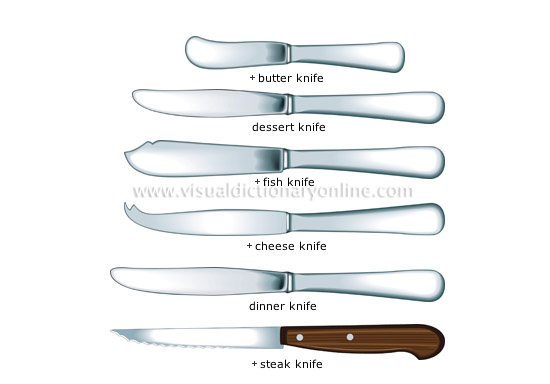
As different objects cannot be cut and chopped by the regular knife, different types of knife are available in the market to make the task easy. Kitchen knifes are used for table service and these type are usually very common. These are usually named after the service they provide such as a dinner knife, luncheon knife, fish knife, butter knife, and the popular steak knifes.
  • One of the most used of the kitchen knifes is the smaller paring knife. A paring knife has a short, pointed blade that is very easy to handle. It is mostly used for quicker jobs such as peeling and removing cores.
  • Kitchen knifes are the most commonly used type of knife today. It seems that everyone who has a kitchen has at least one, although many of us have several that are used for many different purposes.
  • One of the most commonly known of the kitchen knifes is the French knife, also known as a chef's knife. It has a broad, tapered shape with a fine edge that is great for things such as chopping vegetables.
  • A slicing knife, with its long and narrow blade, is used to cut through things such as cooked meat.
Those kitchen knifes that feature scalloped edges are perfect for slicing those foods that are softer, such as tomatoes, bread, and cakes.                                    
Type of Knife and Their Uses 
  • Boning Knife - This knife has a 4-5 inch blade. The blade is flexible and suited for separating meat from the bone.
  • Bread Knife - Bread knife has a 9 inch blade. With the help of its sharp, scalloped blade, the bread can be easily cut without squashing the loaf.
  • Chef's Knife - The Chef knife has a 4-12 inch blade. It is a versatile knife that can be skillfully used for various purposes. However, it comes very handy, while chopping and dicing. You can choose the blade length as per your comfort but make sure you use a longer knife for bigger jobs.
  • Cleaver - This knife comes with a 6 inch blade. It is best suited to chop through the bones and joints of an animal. Moreover, its flat side can be used to crush peppercorns and other spices.
  • Fish Filet - This knife has a 7 inch blade. As the name suggests, this thin, long blade knife has great flexibility for filleting fish.
  • Fork - Fork knife has an 8 inch blade. This is a carving knife's assistant, used to hold meat in place while slicing. Meat can also be transferred from pan to plate with the help of this knife.
  • Ham Slicer - This knife has a 10 inch blade. As the name suggests, it is also a specific knife, specially designed for slicing through the unique texture of ham.
  • Oriental Cleaver - It is a 7 inch blade knife, which is also referred as 'cleaver'. It's really a fine chopper and dicer of vegetables, herbs, meats and fruits. However, it should not be used to chop bones.
  • Paring Knife - A paring knife is designed to be short, sharp, and pointed for easy handling while peeling or mincing. This knife has a 3½-4 inch blade. This is the most commonly used knife in the kitchen, preferred for hand-held tasks, providing utmost control. A paring knife is intended to be all-purpose, just like chef's knife but smaller in size. A paring knife can be an extension of the hand because of its size and lightness.  It is mainly used for peeling fruits and vegetables, and slicing small ingredients. Because it can be used in controlled and detailed cutting, a paring knife is also used in de-veining shrimps, removing seeds from jalapeƱo peppers, and cutting shapes/designs for small garnishes.
  • Birds Beak Knife - It is a type of a paring knife. It is designed for peeling small round fruits and vegetables.
  • Salmon Slicer - It has a 12 inch blade knife. It is long, thin and exceptionally flexible, designed for slicing smoked salmon.
  • Slicer/Carver - This knife has an 8-10 inch blade. It is used for carving paper - thin slices of meats, fruits and vegetables. With the help of the pointed tip, you can cut around bones or pieces of melon.
  • Steak Knife - The Steal knife has a 5 inch blade. This is a sharp knife that cuts through thick steaks and chops.
  • Tomato/Bagel Knife - This knife comes with a 5 inch blade. It is a serrated knife, appropriate for cutting something that's soft on the inside and tough on the outside.
  • Utility Knife - Utility knife has a six inch blade. It can be rightly called a cross between a paring and chef's knife. In effect, it's an all - purpose knife capable of performing a variety of everyday tasks.
Related: 
http://lifestyle.iloveindia.com/
and

Friday, February 3, 2012

Collecting hobbies - Getting started with collectible knives

Knife has been useful tool from the early ages when the first “breeds” of knives were made of stones until now when knives are made of premium quality steel. Knife collecting is a  personal hobby where each individual can select his or her specialty.

What kind of knives are collected?

There are knife collectors that search for certain patterns such as trappers, whittlers, canoes, muskrats, peanuts, folding hunters, etc.

  • Collection of certain handle materials such as stag, mother of pearl, yellow, rough black, green bone, celluloid, etc. 
  • Certain brand names such as Case, Remington, Winchester, Fight'n Rooster, IXL, Queen, etc. 
  • certain blade stampings such as Case Tested, Case XX, Old Remington, New Remington, etc. 
  • Certain specialties (such as advertising, figural, souvenir, etc). 

According to wikipedia: Knife collecting is a hobby which includes seeking, locating, acquiring, organizing, cataloging, displaying, storing, and maintaining knives. Some collectors are generalists, accumulating an assortment of different knives. Others focus on a specialized area of interest, perhaps bayonets, knives from a particular factory, Bowie knives, pocketknives, or handmade custom knives.

The knives of collectors may be antiques or even marketed as collectible. Antiques are knives at least 100 years old; collectible knives are of a later vintage than antique, and may even be new. Collectors and dealers may use the word vintage to describe older collectibles. Some knives which were once everyday objects may now be collectible since almost all those once produced have been destroyed or discarded, like certain WW2 era knives made with zinc alloy handles which are rapidly degrading due to the material's shelf life. Some collectors collect only in childhood while others continue to do so throughout their lives and usually modify their collecting goals later in life.

Getting started with collectible knives.

 1.) Decide yourself how to start off?. Ask questions like, what in knives are you interested most? How did you know about knives and why do you think you have what it takes to be a genuine knife enthusiast?
 2.) Get the sufficient knowledge about that specific category.  To begin, see how you would focus in your collection – should it be by patterns, handle materials, brand names, or specialties. With this, when you are about to purchase collectible knives, you would know which specifications you need.
 a.) To attain sufficient preparation, invest on reference materials such as books and magazines whose markets are knife collectors.  They could provide you with histories, features, news, trends, and knife values.
For example: genuine antique knives are said to be expensive because they did not only survive the tests of time, they are also rare. Take note, they should be antique and not simply looking like antique. Now you know that collectible knives could actually make good investment.
 b.) Aside from print materials, the web will offer you loads of information and most likely, the most updated news about knife auctions, shows and knife forums.
 c.)  There could be thousands of knife makers in the market, but rare are those that produce premium quality products. You can begin the investigation through telephone directories if you wish to hear from them literally. But the reads from magazines, books, and from the internet will make the process easier though.

 3.) Aside from your knives collection, you may also get collectible knives and swords that are useful to you. Some people who are the adventurous and the wild type would prefer knives that can keep up with multitasking and out-of-the-world activities. They would choose hunting knives if they are always in the wild. There are also tactical combat knives which are considered survival knives useful as weapons and for self-defense. Bowie knives could be a wise option in knife collecting too. The most common, are the affordable pocket knives from automatic switchblade knives, fixed knives, and butterfly knives or Balisong. These collectible knives are easier to find, handy, and practical for daily uses as tools.

 4.) Take care of your priced collections. Different kinds of knives require different ways of maintenance and care.
 a.) Keep your knife clean and sharp. If you have knives that you constantly use such as pocket knives and combat survival knives, clean them very often with hot, soapy water and spray them with penetrating oil.
 b.) In cases of antique knives, store them in glass boxes or in their cases. There should be proper waxing or oiling to preserve this knife.
 c.) Sharpen knives. The easiest way is to have a knife sharpener which is available in knife stores.

 5.) Join knife clubs: At these knife collecting clubs or forums you can meet knife collectors, knife makers and professional ones. There could be knife shows, auctions, and the exciting barter of knives! There are also other enjoyable activities such as knife handling and flipping skills and competitions on how to throw a knife!

Souce: 2-clicks-collectableknives

 Useful links:

* Join the online community of knife collectors 'inikfe collector'

Recent Posts

Popular Posts